torook - stock.adobe.com - illustrative purposes only - pictured above is a spider

Human content, AI powered search.

Sign up for our lifestyle newsletter: relationships, romance and real stories, straight to your inbox.
When researchers set out to learn more about bee colonies, they made an amazing discovery. They found evidence that honeybee queens exposed to pesticides can shift some of the contamination onto their eggs to ensure their own survival.
The process is called maternal offloading, and it may protect the queen while putting the colony and her offspring at risk.
"In order to protect herself, the queen bee offloads these chemicals into her eggs to get rid of them," said Sascha Nicklisch, the senior author of the study and an associate professor in the Department of Environmental Toxicology.
"No one has shown this in honeybees before."
Unlike previous studies on honeybees, this research focused on the queen, her ovaries, eggs, and the wax. It turns out that a queen may be willing to sacrifice others to save herself.
Worker bees are the ones who keep everything in the hive running smoothly. The younger workers act as nurses. They tend to the queen and provide larvae with pollen and nectar.
The older workers leave the nest to forage for resources and often become exposed to chemicals like pesticides. They then bring these chemicals back to the colony.
The worker bees do filter out harmful substances from food before it is spread through the hive, but they can only do so much. Queen bees also have a defense strategy of their own.
"In our study, pesticides began to accumulate in queens over time, suggesting that worker filtration capacity can be overwhelmed," said Angela Encerrado-Manriquez, the lead author of the study and a recent PhD graduate from UC Davis.
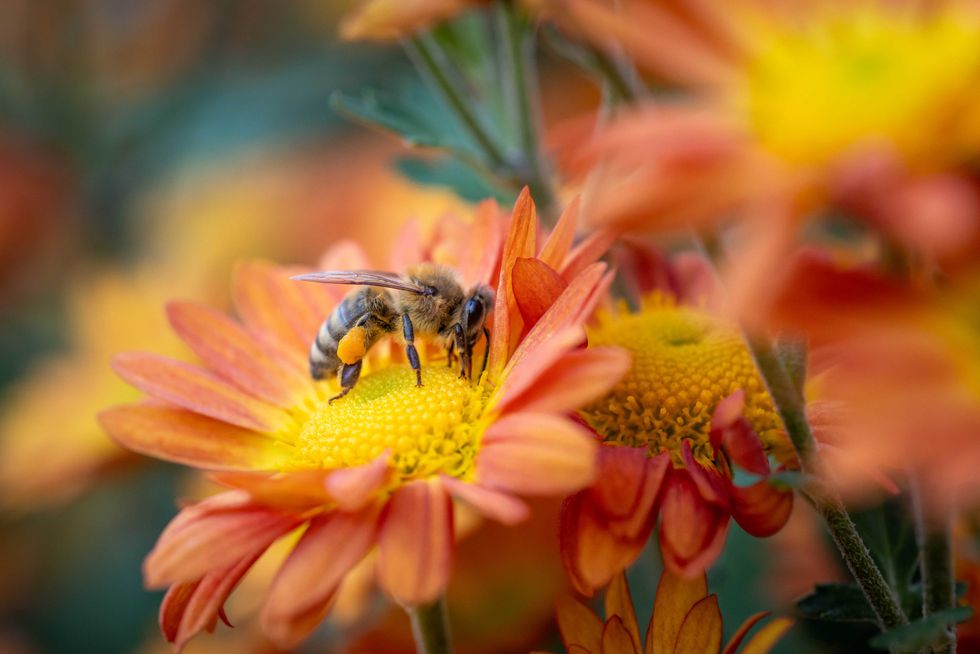 s.botkinphotography - stock.adobe.com - illustrative purposes only - pictured above is a honey bee in the middle of a flower
"When this happens, queens have their own defense. Maternal offloading allows them to shunt the toxic burden to their eggs."
The research team built "nano-colonies," small experimental systems that reproduce key functions in a hive. Each one consisted of one queen and 60 worker bees in a conical plastic container with a netted bottom.
The bees were given pollen, water, and food contaminated with the pesticide methyl parathion. The pesticide was tagged with a low-level radioactive marker, allowing the researchers to track its movement with a technology called biological accelerator mass spectrometry.
On the first day of the experiment, worker bees filtered out 95% of the pesticide and transferred it into the honeycomb, much to the researchers' surprise. By day 10, the levels dropped to 86%.
Overall, the results indicate that pesticides might continue to accumulate in a colony once the colony is exposed to them, especially when worker bees reach the point of being unable to filter the contaminants as effectively.
More research is needed to determine how long queens can continue transferring contaminants into their eggs and how that affects the colony long-term.
The study was published in Current Biology.