torook - stock.adobe.com - illustrative purposes only - pictured above is a spider

Human content, AI powered search.

Sign up for our lifestyle newsletter: relationships, romance and real stories, straight to your inbox.
Over 66 million years ago, a large dinosaur ate a bird, and evidence of that long-ago meal was miraculously intact in the dinosaur's fossilized feces. A feather was preserved in the poop, making it the best feather specimen found from the age of the dinosaurs.
The feather could tell researchers why birds became the only dinosaur group that survived the mass extinction at the end of the Cretaceous Period.
"It's such a beautiful, well-preserved feather, from such an unexpected source, and it's exciting that it could help us answer this huge question in paleontology," said Jingmai O'Connor, the lead author of the study and the associate curator of fossil reptiles at the Field Museum in Chicago.
The oldest known bird, Archaeopteryx, lived about 150 million years ago, and birds continued to evolve alongside other dinosaurs for almost 100 million years.
But 66 million years ago, an asteroid struck Earth and wiped out nearly all dinosaurs and most birds.
One group of birds survived, though. It is known as Neornithes, and every living bird today is a descendant of this group. For years, experts have been trying to figure out how and why Neornithes survived while other birds and dinosaurs perished.
In 2016, David DeMar Jr., a co-author of the study and a research scientist, discovered the feather when he was conducting fieldwork in northeastern Montana. A strange rock had caught his eye, so of course, he had to take a closer look.
"I was crawling up a rocky outcrop collecting fish fossils when I came across a dark, reddish-brown nodule about half the size of a golf ball," he said.
"I picked it up and scanned its surface through my hand lens, and that's when I couldn't believe what I was seeing, a tiny fossil feather."
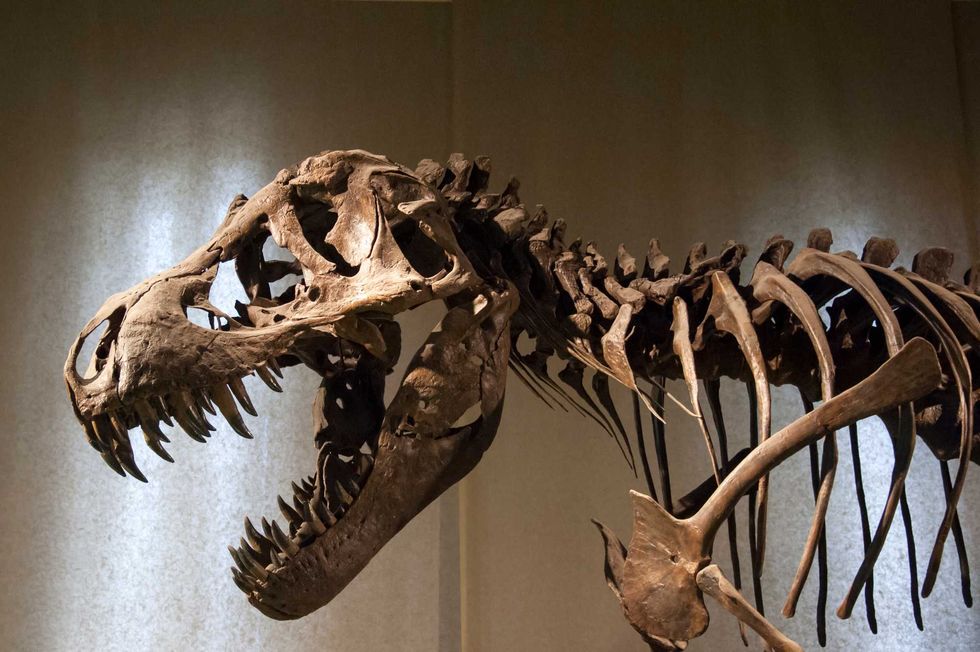 atm2003 - stock.adobe.com - illustrative purposes only - pictured above is a Tyrannosaurus rex skeleton
It was the first time that a feather had been found in the Hell Creek Formation after more than 150 years of searching the area. Researchers examined the fossil's mineral composition and took CT scans of it. They identified it as a coprolite, the scientific term for fossilized animal feces.
Inside the coprolite, there were multiple feathers, small scales from a gar fish, and the leg bones of a hesperornithiform bird. The researchers believe that the feathers all came from the same bird.
"Hesperornithiforms were aquatic birds, ecologically similar to loons," said O'Connor. "Most couldn't fly, and instead, they used their specialized feet to dive down into the water to hunt for things like fish. The feathers showed adaptations for being underwater that we see in living aquatic birds."
Hesperornithiforms were close relatives of Neornithes, but they belonged to a separate lineage and vanished along with the other birds after the asteroid impact.
Neornithes may have survived because of the differences in their feathers. Their feathers may have trapped heat more efficiently, allowing them to withstand cooler temperatures. The asteroid collision caused dust and debris to rise up into the atmosphere, blocking the sun.
Overall, the rare feathery find has helped researchers gain more insight into the biology and evolution of birds. It's possible that more coprolites could contain similar discoveries that have gone unnoticed because no one thought to look into them until now.
The study was published in Current Biology.